The Books They Tried to Burn

Book Banning: What It Is, How It Works, and Why It Matters
In recent years, book banning, in the United States especially, has moved to a widespread and common practice. According to PEN America, nearly 23,000 book bans have been documented in public schools nationwide since 2021; record highs on all accounts. This scale of censorship is unprecedented in modern American history. At no other point have so many books been removed from school and public libraries, nor have so many states created laws or regulations designed to make censorship easier or more enforceable to this degree. Entire categories of stories, themes, even research papers, are being erased from classrooms, often through pressure campaigns by organised groups, parents and politicians, that intimidate educators and threaten critical funding.
The books most frequently targeted are ones that explore political extremism or dystopian themes, race and racism, feature characters of colour or LGBTQ+ identities, or address sexuality and sexual violence in ways deemed uncomfortable or controversial.
In effect, the stories being removed are often those that reflect the lived realities of marginalised communities or opposing ideologies.
“The freedom to read is the freedom to think. Banning books is an attempt to control thought.” Isaac Asimov once said.
What are the ramifications for banning books like The Handmaids Tale by Margaret Atwood, which explores extremely important themes around bodily autonomy for women, set in the backdrop of a dystopian future where women are treated as property? What are the ramifications of removing stories that give accounts of lived experiences through dictatorship or troublesome regimes?
Stories matters, books matter, representation matters. Let’s explore book bans, how they are implemented; and what comes next.
The Scale of Book Bans in 2025-2026
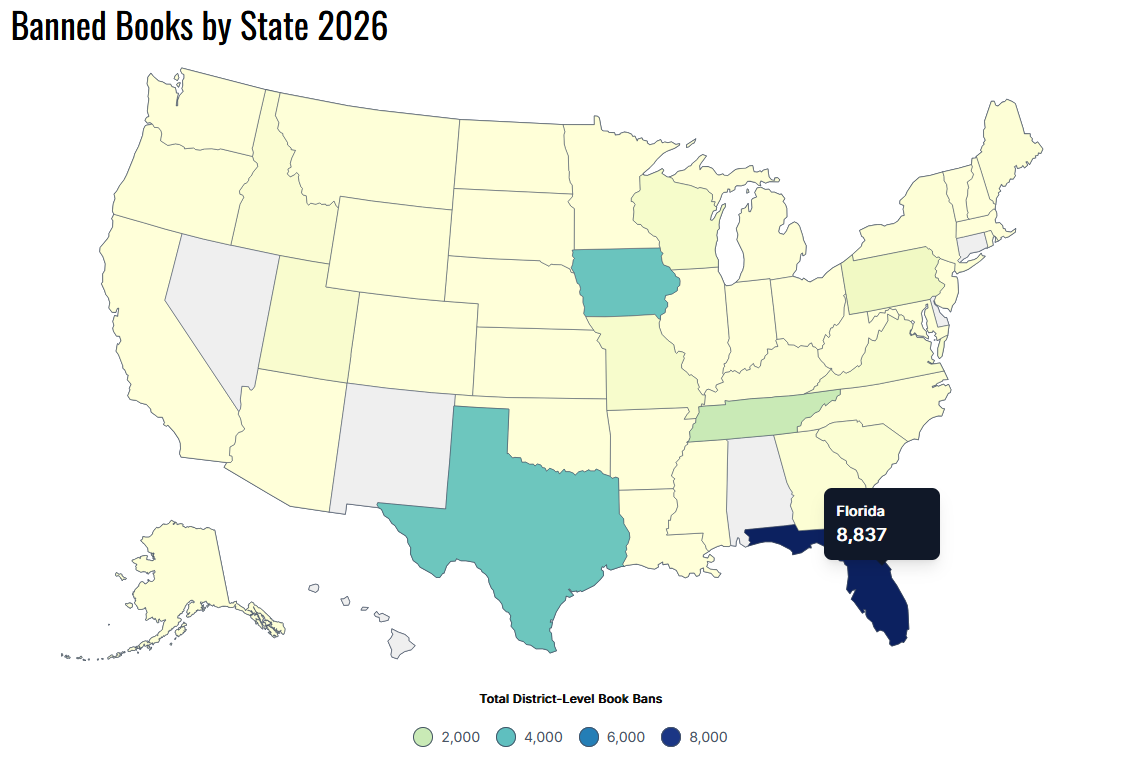
Statistics from PEN America
During the 2024–2025 school year alone, PEN America recorded an incredible 6,870 instances of book bans, affecting nearly 4,000 unique titles. Florida led the nation, with 2,304 bans, followed by Texas with 1,781 and Tennessee with 1,622. Among the most banned books were well-known works such as A Clockwork Orange by Anthony Burgess, titles from Sarah J. Maas including A Court of Thorns and Roses and A Court of Mist and Fury, and Jodi Picoult’s Nineteen Minutes, a novel examining the aftermath of a school shooting.
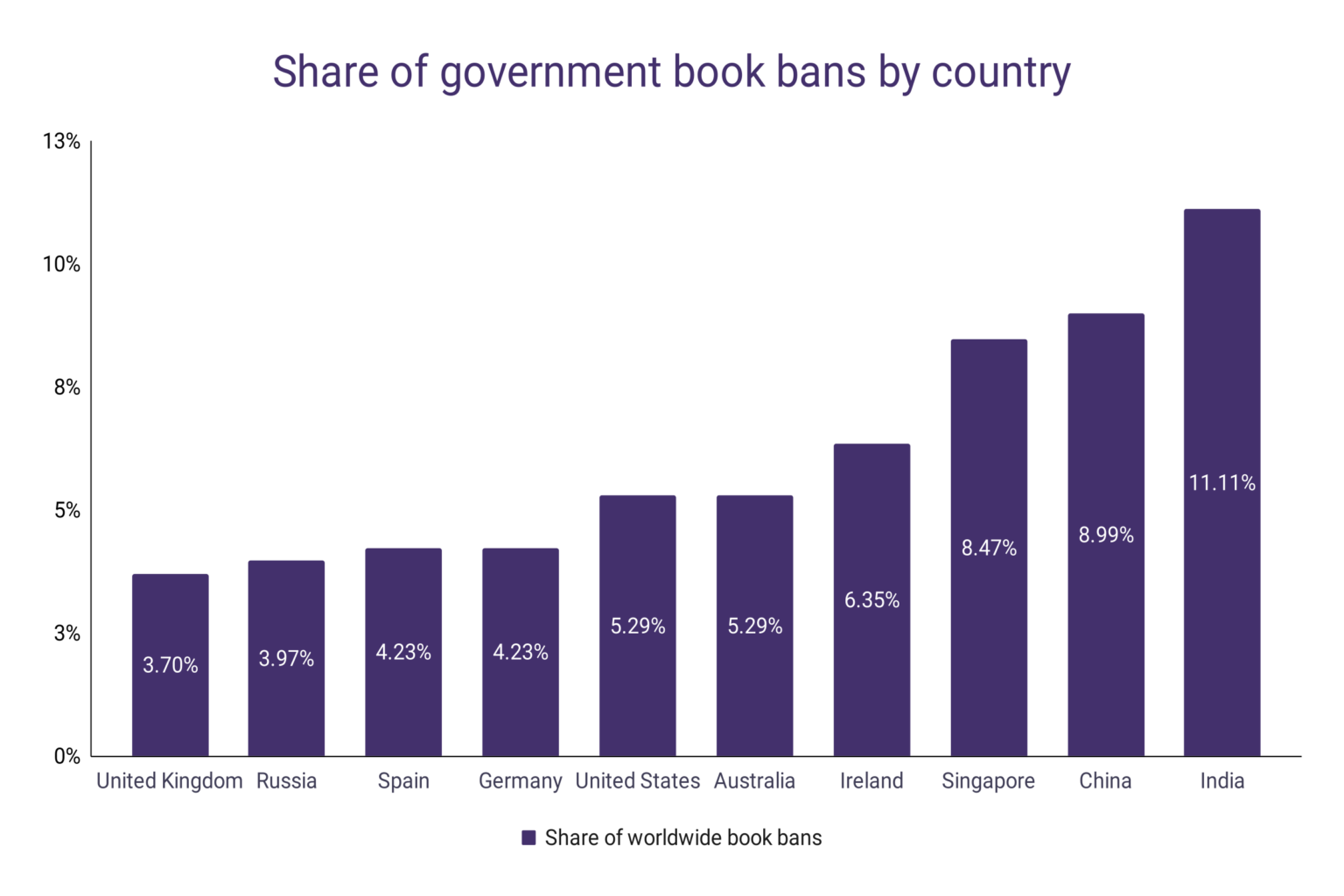
These numbers do not merely represent books removed from shelves in libraries or from reading groups. They represent lost and censored access to the free exchange of ideas, and understanding at a formative stage of life. Book bans happen all around the world. Indian police raided bookstores in August last year in the region of Kashmir after authorities banned 25 books for allegedly promoting “false narrative and secessionism”.
The order banning the books threatened people with jail time for trying to sell or even owning works by authors like Booker-winning novelist Arundhati Roy, constitutional scholar AG Noorani, and historians Christopher Snedden, Sumantra Bose and Victoria Schofield.
Human beings rely on information and stories to make sense of the world; we always have. Stories are often passed down from generation to generation, survived through writing, imagery, hieroglyphics, art. Stories give shape to experience, help us articulate identity and nuanced topics about the human experience, and allow us to imagine different futures.
Removing books from schools is therefore not a neutral or harmless act. It reshapes what young people are allowed to know about themselves and others.
As educator Dr. Rudine Sims Bishop has warned:
“When children cannot find themselves reflected in the books they read, or when the images they see are distorted, negative, or laughable, they learn a powerful lesson about how they are devalued in the society of which they are a part.”
Stories help children understand who they are and who they might become. When those stories disappear, entire groups are pushed further to the margins.
What Is a School Book Ban?
PEN America defines a school book ban as any action taken against a book to restrict its access or distribution because of its content, following a challenge by parents or community members, an administrative decision, or pressure from government officials. A ban officially occurs when a book is removed entirely from student access, public libraries or when access is limited in meaningful ways; including but not always limited to commercial distribution.
Accessibility is central to this definition and conversation. Books in school libraries or curricula are selected by trained educators and librarians as part of a school’s educational mission. A ban occurs when those professional judgments are overridden due to objections to a book’s ideas, themes, or representation.
For the 2024–2025 school year, PEN America identified three main forms of bans: books that were fully prohibited, books removed while under investigation, and books restricted through age limits or parental permission requirements.
Political Pressure and Policy Influence
Although recent federal executive orders did not explicitly mandate book removals as an outlined item, they have played a significant role in encouraging censorship because these orders are often used to justify the means to ban books. Executive actions such as “Ending Radical Indoctrination in K–12 Schooling” and “Defending Women From Gender Ideology Extremism” have been cited as justification for large-scale removals. In July 2025, nearly 600 books were taken out of Department of Defense Education Activity schools on military bases, including titles such as ABC of Equality by Chana Ewing.
At the same time, the U.S. Department of Education dismissed concerns about book bans as ‘exaggerated’ and dismantled a federal role tasked with investigating discriminatory censorship. It issued guidance warning schools against the use of race-related frameworks, threatening the loss of federal funding.
Another executive order sought to reduce or eliminate federal oversight of education altogether, shifting authority entirely to states and local governments. Without national guardrails, states gain broad power to impose ideological control over public education, further increasing the risk of censorship.
One of the most troubling findings from PEN America’s research is that many bans do not result from formal review processes or explicit legal requirements and guideline frameworks. In the 2021–2022 school year, only 4% of banned books followed established reconsideration procedures. By 2024–2025, the pattern remained similar but still, an unprecedented amount of books have been banned.
In many cases, books were removed preemptively. School boards, administrators, and educators acted out of fear that they might violate future laws or provoke political backlash. PEN America identified 2,520 cases in which bans were influenced by the presence or threat of state legislation. Yet only 3% of those cases were directly mandated by law. The remaining 97% stemmed from anxiety about potential noncompliance.
This phenomenon, often described as “obeying in advance,” results in widespread self-censorship. Educators avoid topics that might be considered risky, even when no law explicitly requires removal.
State-Mandated “No Read” Lists
Some states have gone further by creating formal mechanisms for statewide bans. In 2024, Utah and South Carolina introduced “no read” lists that automatically prohibit certain titles across all public schools once specific criteria are met. An example of what is on these “no read” lists is Sarah J Maas’s Kingdom of Ash, which explores themes of political conflict and the fight in good vs evil, and resisting tyranny. Tennessee enacted a similar policy, though it has not yet been used.
In Utah, for example, a book must first be banned in multiple districts before being placed on the statewide list. Once added, the book becomes inaccessible across all districts. Although it is difficult to measure the precise impact, estimates suggest that a single title added to such a list could result in hundreds of removals statewide.
Why This Moment Matters
Book banning is not only about literature. It is about power, the writing of history, and whose experiences are allowed to exist in public spaces. When access to stories is restricted and censored, especially regarding stories that reflect marginalised lives or experiences, society loses an opportunity to cultivate empathy and critical thinking. We risk failing to learn important lessons so that problematic history does not repeat itself.
The current wave of censorship represents a critical point in time. It challenges long-standing principles of intellectual freedom and educational integrity.
At stake is not just what children read, but what kind of society we are willing to build.

